Why Every Founder Needs an Adversarial Mindset (Even If You're "Too Small to Be a Target")
The "we're too small for hackers" assumption has bankrupted more startups than bad product-market fit. Here's how to think about who might attack your business — and what to do about it before you ship.
Most early-stage founders I talk to put security somewhere between "compliance theater" and "we'll fix it after Series A." The reasoning sounds rational: you have ten users, no money, and no obvious enemies. Why would a hacker bother?
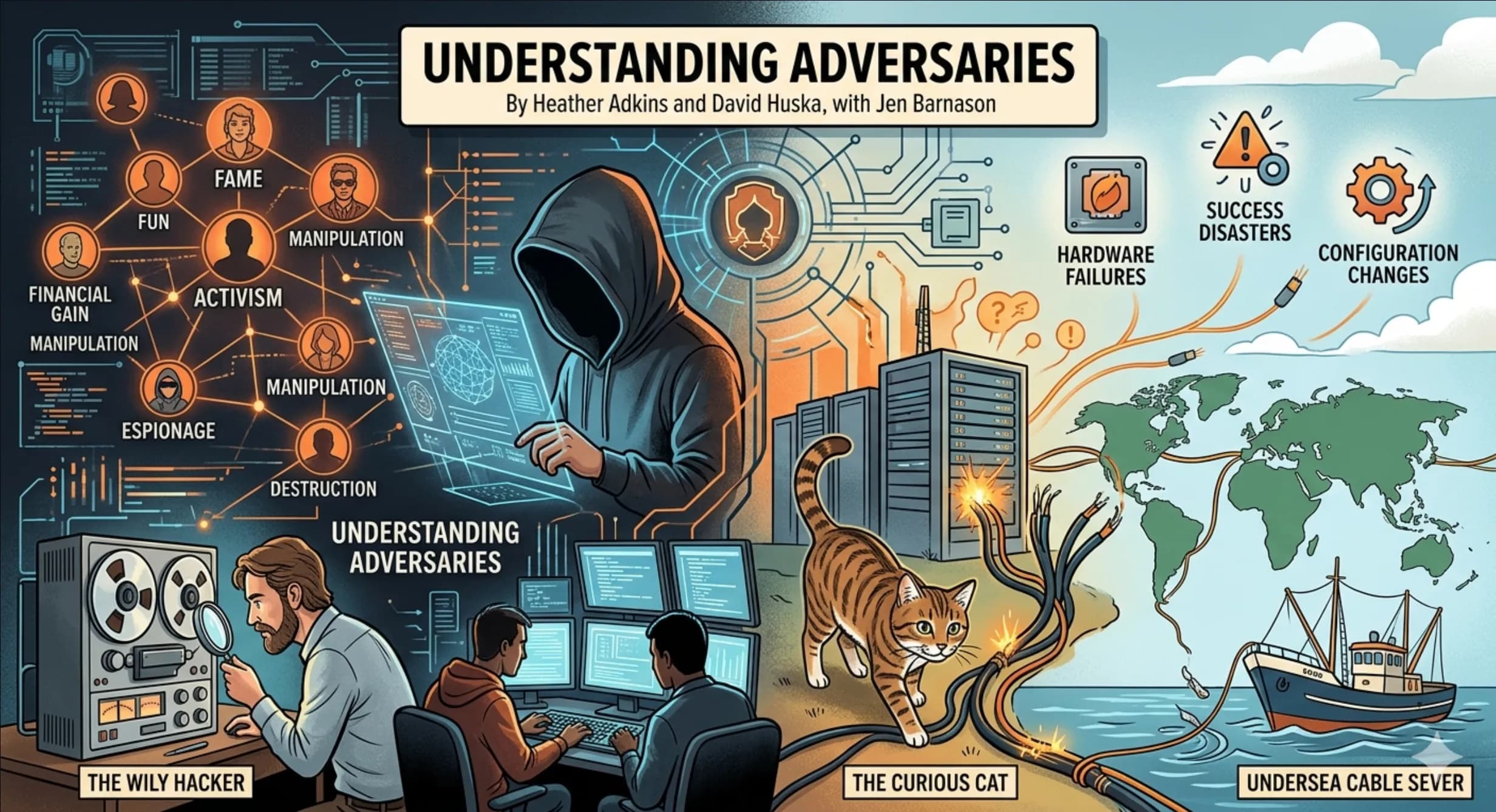
Because the people attacking your systems rarely fit the hoodie-in-a-basement stereotype — and they almost never care about you specifically. They care about what you can be used for.
This post is a practical primer on adversarial thinking: a habit of looking at your own product the way someone trying to break it would. You don't need to become a security engineer. You need to ask better questions before you ship.
Step 1 — Who would actually want to attack you?
Forget Hollywood for a second. The real attacker categories that touch startups look like this:
Opportunistic criminals. They scan the entire internet for known vulnerabilities and ransomware-target your database the day after a CVE drops. They don't know you exist. They don't need to.
Competitors and adjacent insiders. A disgruntled former contractor, a competitor scraping your API, a co-founder who left on bad terms.
Customers behaving badly. Users who try to abuse free tiers, manipulate referrals, or scrape data they shouldn't access.
Activists and brigades. If your product touches anything political — content moderation, payments, identity, region-specific compliance — you can become a target overnight.
Sophisticated actors. Rare for early-stage startups, but possible if you serve customers who are targets (defense, journalism, crypto, healthcare.
Notice that most of these don't require you to be famous. They require you to be reachable and valuable for some purpose — even just as a launchpad for attacking someone else.
In 2012, Adobe got compromised so attackers could sign their malware with Adobe's certificate. The actual target wasn't Adobe — it was Adobe's customers. If your startup signs anything, hosts user content, or has any kind of trust relationship with bigger systems, you're potentially in the same boat.
Step 2 — What are they actually trying to do?
Motivation matters because it changes what you should defend.
Money. Ransomware, payment fraud, account takeover, crypto draining.
Data. Customer PII, internal docs, source code, embedded credentials.
Disruption. DDoS, defacement, mass spam from your domain.
Leverage. Using your infra, certs, or domain to attack someone else.
Personal. A fired employee, a stalker abusing your app's location features.
If you're processing payments, money is on the table. If you store user messages or location data, intelligence-grade actors are theoretically interested even if they're not interested yet. If you let users host content, expect abuse the day you launch.
Step 3 — Don't forget the people inside
The hardest threat model for founders isn't external. It's the people you trust.
The contractor you onboarded in week two who still has a database password in their notes app.
The co-founder who has root on prod and pushes "small fixes" at 2 a.m. without review.
The open source dependency maintained by one person you've never met.
The intern's laptop, unlocked, on a shared kitchen table.
Most "hacks" of small companies are actually variations of this: someone with legitimate access did something they shouldn't have — sometimes maliciously, more often by accident. The fix isn't suspicion. It's least privilege: nobody (including you) should have more access than the minimum required to do their current task.
Step 4 — Sophistication is overrated
Founders love to fantasize about state-level attackers and zero-days. Real breaches almost always come from boring stuff:
A reused password.
A phishing email.
A leaked API key in a public Git commit.
An unpatched dependency from 2019.
An S3 bucket set to public.
Before you spend a single hour on exotic threats, fix these:
Two-factor authentication everywhere. Email, GitHub, AWS/GCP, Stripe, your domain registrar. Especially the registrar.
Secrets out of code. Use a real secrets manager. Rotate anything that ever touched a Slack DM.
Dependabot or equivalent on day one. You will forget to update. The bot won't.
Audit logs you actually read. A log nobody looks at is theater.
Backups you've actually restored. Same.
This is unglamorous work. It's also the only work that consistently matters at the scale most founders operate at.
Step 5 — Think in stages, not in single events
A useful mental model: attacks rarely happen in one move. They go recon → entry → lateral movement → persistence → goal. Defense in depth means assuming one layer will fail and asking what catches the attacker at the next stage.
Phrased as questions for your own product:
Recon: What information about my company, employees, and infrastructure is public? (Spoiler: more than you think.)
Entry: What's the easiest way someone gets a foothold? (Usually: phishing, leaked creds, exposed admin panel.)
Lateral movement: If they own one employee laptop, can they reach prod?
Persistence: Would I notice if someone added a new SSH key, OAuth app, or service account?
Goal: What's the worst thing they could do once inside? Can I make that single thing harder?
You don't need a SOC. You need to know that at every stage there's at least one thing that would slow an attacker down or make noise.
The takeaway
Security at startup scale isn't about being unbreakable. It's about being expensive enough that opportunistic attackers move on to easier targets, and observable enough that targeted attackers can't operate quietly.
You can't predict every threat. You can adopt the habit of asking, before every feature ships: who would abuse this, and what would they do with it?
That question, asked early and often, is worth more than any tool you'll buy.
Part of the MoyoLab team building AI-powered products and platforms for founders and growing teams.
Share this article
Related Posts

I thought AI was going to make me lazy. Then I started treating it like a colleague.
For months I avoided using AI for "real" engineering work, afraid it would make me lazy. Then I changed how I worked with it — not as a slot machine, but as a colleague. Here's the pattern that flipped the relationship and made me sharper, not duller.

Secure Coding Practices Every Developer Should Know
From input validation to dependency management, here are the essential secure coding practices that protect your applications from the most common vulnerabilities.